How to put on snow chains correctly: step-by-step instructions
Steffen shows you how to put on snow chains with step-by-step instructions. He also gives tips on what you need to consider when driving with snow chains.
When do you need snow chains? If there is a solid layer of snow on the road, then you must fit snow chains.
According to German law, carrying snow chains is not mandatory – there is no general obligation to use snow chains. However, if you see a roadside sign with a tire with snow chains on a blue background, you must fit snow chains on your car.
In Austria, it is mandatory to carry winter equipment in your car from November to April. Winter equipment also includes snow chains.
When buying snow chains, it is important that you get the right snow chains in the right size for your tires. The size of the snow chains is indicated on the tire, in the manual, or you can ask your dealer.
You should install the snow chains on a flat surface and in a safe place away from other road users. On mountain passes, there are often designated parking areas for fitting snow chains.
Depending on the vehicle type, there are different mounting points for snow chains. With front-wheel drive, the snow chains are mounted on the front drive wheels, i.e., on the left and right tires on the front axle. The reverse is true for rear-wheel drive, and with all-wheel drive, you can fit snow chains on all four wheels.
When fitting snow chains, you should turn on your hazard lights and wear a high-visibility vest.
The snow chain consists of:
- Mounting ring, which goes behind the tire
- Tensioning chain, which goes on the tire
- Fasteners for securing and tightening the chain
Since the mounting ring goes behind the tire, you must thread the snow chain underneath your car behind the tire. It is important that all links of the chain are exposed. The ends of the mounting ring must be connected. To do this, you must close the ends together inside the wheel arch.
Then tighten the chain around the tire. To do this, you need to pull all the chain elements forward and distribute them so that they enclose the tire. The tensioning chain is now on the tire. Now the chain only needs to be secured to the tire.
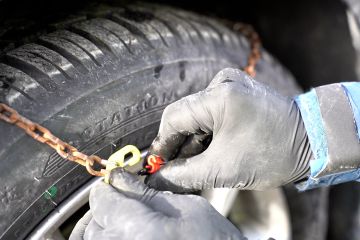
The fasteners are usually marked. In Steffen's case, he closes the yellow hook with the red-marked chain link. This means that the upper part of the tire is enclosed by the chain. On the lower part of the tire, Steffen has an automatic locking mechanism that is responsible for tensioning the chain. To do this, he closes the other yellow hook with the red-marked wire of the locking mechanism. To tighten the chain, Steffen presses the button of the locking mechanism.
The snow chain is not yet perfectly aligned with the tire and is not yet synchronized, so you need to drive your car 100 to 200 meters and then check whether you need to re-tighten the chain.
The snow chains make the car handle differently. The chain gives you much better grip, which helps when going uphill. Driving downhill is much safer because you won't slip when braking, but instead your car will have a firm footing on the road.
With snow chains, you can only drive at a maximum of 50 km/h. Turn off all of the car's driving aids designed to prevent tire spin, as this is important so the snow chains can build up enough grip. Steffen still recommends not letting the chains spin too often, as this will damage the chains.
If you're driving with snow chains for the first time, you should get used to the new driving style slowly, as the car will behave differently.
Removing them is easier than installing them. You pull out the wire of the tensioning element by pressing a button. This will loosen the chain again. You can now release the hooks. After that, you can loosen the lock on the mounting ring. You may have to move the car forward or backward slightly to reach the lock inside the wheel arch. Now you can place the chain on the ground. Since the tire is still on the chain, you have to drive your vehicle forward or backward a little, then the chain will lie freely on the ground.